
Start here: size and fit are different things
Here is the single most useful thing to understand about bras. Knowing your usual size is not the same as having a bra that fits. A bra can technically carry your size on the label and still fit badly: the band can creep up, the cups can gape, the wires can sit in the wrong place. Size is the starting point. Fit is the verdict. That distinction is the foundation of these bra basics, and everything below builds on it.
Many of us learn this late. In our teens and early twenties, most of us judge a bra by two rough tests: the band does not feel too tight, and the cups seem to cover everything. If both pass, we assume the job is done. It feels reasonable, but it misses almost everything that makes a bra comfortable through a full day. This guide explains what the number and the letter actually mean, how to find your starting size, and how to check the result on your own body. No experience needed. If you can use a soft measuring tape, you can follow every step below.
How to use this guide: read the first four sections in order if bra sizes have always confused you, since each builds on the last. Use the table of contents on the left to jump straight to sister sizes, international labels, or care if you already know the basics. Every section ends where your mirror takes over, because no article can confirm a fit that only trying on can prove.
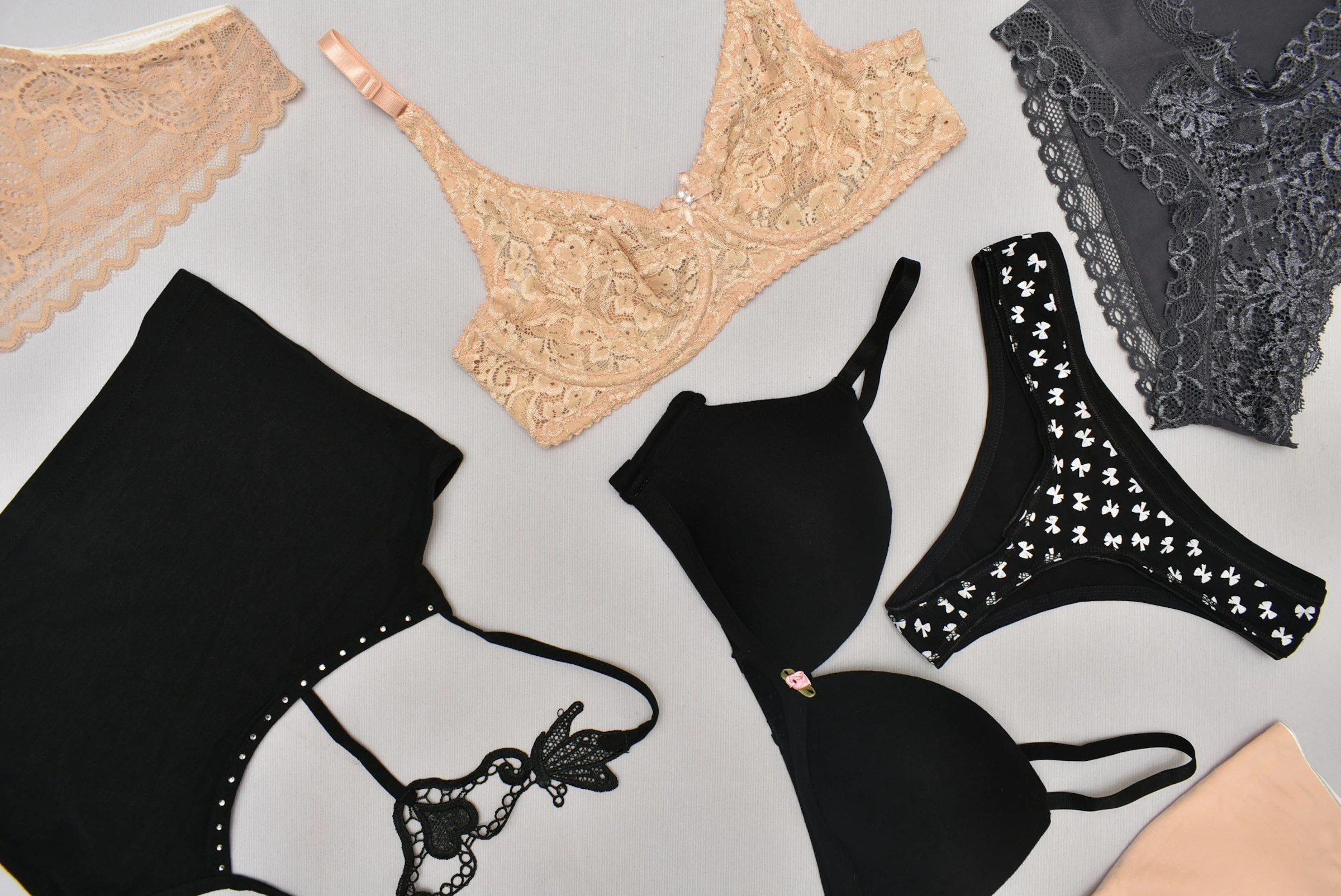
The two parts of a bra size
Every bra size has two parts that work together: a number for the band and a letter for the cup. A 34C means a 34 band with a C cup. Neither part means much on its own, and misunderstanding either one causes most fitting problems.
The number describes the length of the band around your ribcage, in inches for UK and US sizes. It does the heavy lifting: a well-fitting band provides most of the support, around four-fifths of it, with the straps handling the rest.
Band feel changes with age, so judge it correctly. A new band should fit on the loosest hooks, feeling snug but breathable. Elastic relaxes with wear and washing, and the tighter hooks exist precisely for that drift: migrating inward over months keeps the same bra supportive for longer. If a brand-new bra only fits on the tightest hooks, the band is too big from day one. Ribcages differ too. On a firm, bony ribcage the same band feels tighter than on softer tissue, which is why two people with identical underbust numbers sometimes choose different bands. Neither is wrong. Comfort under the tape-equivalent tension is the test, not the number.
If your straps dig in while doing all the work, the band is usually the culprit, not the straps.The letter describes the cup size, but only relative to that band. It comes from the difference between your bust measurement and your underbust measurement. Roughly one inch of difference per step: about an A for one inch, B for two, C for three, D for four, DD for five, E for six, and so on. Because it is a difference, not an absolute volume, the letter cannot be read alone. Hold that thought. It is the key to everything below.
Cups also come in shapes, and shape decides as much as size. A balconette lifts from below with wide-set straps and suits many average projections. A plunge has a low centre for deep necklines but offers less separation. A full-cup contains everything with maximum coverage, often best for fuller or softer tissue. A demi covers roughly half, suiting smaller or firmer shapes. A minimiser redistributes rather than reducing anything. None is better in general. If one shape gapes while another in the same size fits, you have learned something about your shape, which is more valuable than a new number.
How to find your starting size
You need a soft measuring tape and two numbers. First, your snug underbust: wrap the tape around your ribcage directly beneath your breasts, level all the way round, pulled snug but not painfully tight. Breathe out normally and read the number. Second, your standing bust: wrap the tape around the fullest part without compressing anything, arms relaxed, tape level. A mirror helps you check the back.
Now the simple version. Round the underbust to the nearest even number for your band. Subtract it from the bust for your cup. Take a concrete example: an underbust of 32 inches and a bust of 36 inches. The band is already even at 32. The difference is four inches, which suggests roughly a D cup. Starting size: 32D in UK or US sizing.
Our bra size calculator runs this exact method, accepts centimeters too, and shows the matching international sizes. The full measuring walkthrough, including common tape mistakes, lives in our guide to measuring with a tape.More verified pairings from the same method: 30 under with 35 bust gives 30DD. 38 under with 42 bust gives 38D. 28 under with 33 bust gives 28DD. Between readings, round to the nearest whole inch and let the try-on decide. Between bands, band feel breaks the tie: firm ribcages usually prefer the larger band, softer tissue the smaller one.
Treat whatever you get as a starting size, not a final answer. Two measurements cannot capture breast shape, spacing, firmness, or how a particular brand cuts its cups. The number tells you which fitting room to walk into. The checks later in this guide tell you whether to stay.
The same-letter myth: a D is not a D
The biggest misconception in bra sizing is that a cup letter always means the same thing. It does not. A 30D and a 36D have very different cup volumes, because the letter only describes the difference on its own band. A D on a small band is a small cup. The same D on a large band is a large cup.
This trips up almost everyone at some point. If you wear a 34D and your body changes so you need a 38 band, keeping the D and buying a 38D quietly increases your cup volume. Nothing about your breasts changed except the frame they sit on, yet the cups got bigger. Once you see the letter as relative, a lot of confusing fitting-room experiences suddenly make sense.
Related mistake: treating the old plus-four method as a universal rule. Adding four inches to the underbust dates from the era of rigid, non-stretchy fabrics. With modern elastic bands cut to actual ribcage measurements, it usually lands you on a band too loose to anchor anything, and then every other fit problem follows. Start from your real underbust instead.
One more: assuming that/cup gaps always mean the cup is too large. Sometimes they do. But gaping can also mean the cup shape does not suit your breasts: too tall, too wide, or the wrong projection. When the volume seems right but the edges will not lie smooth, try the same size in a different cut before sizing down.
Sister sizes, simply explained
Sister sizes are different band-and-cup combinations that hold approximately the same cup volume. The rule fits in one sentence: down one band and up one cup for a tighter band, up one band and down one cup for a looser one. So 32DD, 34D, and 36C are sisters. So are 32D, 34C, and 36B.
A concrete example shows why this matters. Imagine someone measured as a 36B, but the band rides up through the day while the cups gape slightly. Moving to a 34C keeps roughly the same cup volume on a firmer band, which often fixes both symptoms at once: better anchoring, closer fit. Whether it works for a given body depends on shape, which is why sisters are candidates to try, not answers to buy blind.
Reach for a sister when the cups are close but the band is wrong, when you fall between bands, or when your exact size is out of stock in a style you love. Move only one step at a time. Our sister size finder computes both directions for any starting size.
Find my sister sizesCommon sister groups worth knowing: 30B with 28C and 32A. 32D with 30DD and 34C. 34D with 32DD and 36C. 36D with 34DD and 38C. Read each row as same cup volume, three band options. Start in the middle and move only when the band tells you to.
Sister vs true size, wired vs wireless
Two choices confuse shoppers more than any others, so here they are side by side. First, sister size versus true size. Your true (measured) size is always the starting point. A sister is the right move when the cup volume feels right and only the band needs changing. It is the wrong move when the cups themselves misbehave: spilling means the volume is too small, gaping with the right shape means it is too big. Fix the cup first, then revisit the band.
Second, wired versus wireless. Neither is automatically better. Wired bras give a more defined shape and support when the wires sit around the breast tissue without digging in or resting on it. Wireless bras can be more comfortable for everyday wear, lounging, or anyone who dislikes underwires. One honest difference: sister-size logic was developed around wired bras, where band and wires share the work. In wireless styles the band does nearly everything, so band feel dominates and exact cup-volume equivalence matters less. Choose by fit, activity, comfort, and construction, in that order.
Wireless styles deserve their own map because they behave differently. A bralette offers light support with minimal structure, best for smaller busts or low-activity days. A longline extends the band lower on the torso, spreading support over more area, which some find more comfortable than a standard band. A sleep or lounge bra prioritises softness over shape and should never be judged by daytime support standards. Judge each wireless style by what it promises: stability for longlines, comfort for loungewear, and honest band tension for everyday wireless bras.
The anatomy of a bra
A bra has five working parts. The underband anchors everything around your ribcage and provides most of the support. The cups contain and shape each breast; their edges should lie smooth, with no spilling and no empty space. The centre gore, the small panel between the cups, should sit comfortably against your chest on most wired bras (wireless styles and some body shapes exempt).
Centre gores vary more than shoppers expect. A high gore separates fully and suits most wired styles. A medium or low gore (sometimes called a plunge gore) tacks lower, which helps close-set breasts that cannot accommodate a tall panel between them. Wide-set breasts have the opposite issue: plenty of room, but cups that cut too far inward can still press tissue. If the gore will not settle in any size, the style geometry, not you, is usually at fault. This is common enough that gore fit deserves its own check rather than being lumped in with cups.
The straps position the cups and should stay put without digging in; if they carry all the weight, the band is too loose. In wired bras, the underwire should follow the root of the breast without pressing on breast tissue.Knowing the parts turns vague discomfort into a diagnosis. Band rides up? Band problem. Spilling? Cup problem. Gore floats? Cups too small or shape mismatch. Straps digging? Band too loose, forcing straps to compensate. Each symptom points at a part, and each part points at a fix.
Two adjustments solve most strap and wire complaints. For straps, tighten until they stay put through normal movement, then stop: if you need them painfully tight, the band is too loose and no strap setting fixes that. The two straps need not match; slightly different lengths for asymmetric sides are normal. For wires, the common faults are sitting on tissue (cups too small or too narrow), floating at the centre (cups too small), and digging at the sides (band too tight or wires too narrow). Each fault names its fix. Never bend wires yourself to force a fit; a wire fighting the body means the size or shape is wrong.
UK, US and EU labels without tears
The same bra can wear three different labels, and assuming they match is the fastest route to ordering the wrong size. Here is how the systems relate. UK and US bands are usually the same number. UK and US cups match up to DD, then diverge: a UK E is generally a US DDD, a UK F roughly a US G. EU bands use centimeters, so a 34 band is about a 75; EU cups follow their own alphabet on top of that.
The practical rule: never assume, always check. Retailers do not always state which system a label uses, and brand grading varies on top of the system differences. Convert with our size converter, then confirm against the brand's own chart before buying. Our full
EU sizing deserves a closer look because it confuses even experienced shoppers. The band number is roughly the underbust in centimeters: 70, 75, 80, 85 line up with 32, 34, 36, 38. The cup letter then works like any other relative letter. Conversion between systems is therefore two independent lookups, band and cup, not one formula. The practical consequence: convert first, then verify against the brand chart using your actual measurements in centimeters, since the chart describes bodies while the label only names the size.
US to EU conversion guide works through the mapping with tables. Compare size labelsBuying online rewards a simple protocol. Convert the size, check the brand chart against your tape numbers, and order the calculated size plus its closest neighbour or sister when free returns allow it. Try everything on arrival using the four checks, keep the winner, and write down the exact size, style, and brand that worked. That note becomes your personal chart, more reliable than any generic table, because it records what fits your body rather than what should fit it in theory.
Where standard advice fails
Charts assume a symmetrical, average body. Real bodies vary, and knowing where the method bends keeps you from blaming yourself. Asymmetry is normal: most people have one slightly larger breast. Fit the larger side; a small gap on the smaller side is expected, not a sizing error. Shape matters as much as volume: fullness, spacing, projection, and root width all decide which cuts work. Two people with identical measurements can need different bras.
Hormones and life stages move the target. Pregnancy, nursing, and hormonal shifts change size and sensitivity, so a previously perfect bra can stop fitting through no fault of its own. Re-measure when things change rather than fighting the old size. Sports bras play by partly different rules: support depends on activity level and whether the design compresses, encapsulates, or both. Your everyday size is the starting reference, but bounce-test before committing, because still-mirror fit says little about fit in motion. In every case the principle holds: measurements narrow the options, the body makes the decision.
A few shape words help you read product descriptions. Projection is how far tissue extends outward; projected shapes often suit seamed, narrower cups, while shallow shapes suit wider, taller ones. Root width is where tissue attaches to the chest; narrow roots spill out of wide wires and vice versa. Fullness describes where tissue sits: fuller on top, fuller on bottom, or even. None of these are sizes, which is exactly why two people with identical measurements need different bras. Descriptions mentioning projection, root, and fullness are a sign the brand understands fit.
Sports bras deserve their own note because still-mirror fit says little about fit in motion. Encapsulation styles support each breast separately and usually follow everyday sizing. Compression styles press tissue to the chest and often use S/M/L sizing from a separate chart. Match the support level to the activity: walking, running, and jumping impose very different forces. Whatever the style, bounce-test before committing, since comfort standing still predicts nothing about comfort at pace.
Pregnancy and nursing change the landscape further. Size can shift across trimesters, sensitivity rises, and sleep bras or soft-cup styles often replace wires for stretches of time. The practical approach is to re-measure when things change, buy for the current body rather than any hoped-for one, and expect to revisit sizing again later. Flexibility beats precision in this season.
Trying on: the four checks
Use these every time, in order. One, the band. Fasten on the loosest hooks of a new bra; it should sit level front to back and feel snug. This leaves room to tighten as the elastic relaxes with wear. Two, the cups. Settle everything in, then look for smooth edges: no spilling over the top or sides, no wrinkling or empty space. Three, the gore and wires. The centre panel should rest against your chest, and wires should encircle the breast root without pressing on tissue. Four, the straps. Adjusted to stay put without digging, carrying only a small share of the weight.
Then move. Sit down, breathe normally, raise your arms, lean forward. A bra that only fits while you stand statue-still in a fitting room will not survive a day. Our fit checker turns these four into an interactive checklist you can run through on your phone.
A fitting-room routine that works: start with your calculated size plus its two sisters, three bras in the same style if possible. Lean forward and settle all tissue into the cups before judging anything. Check band, then cups, then gore and wires, then straps, in that order, because each step assumes the last. Sit, breathe, reach, twist. Eliminate decisively and compare only the survivors. Note the winning combination of size, style, and brand for next time, since memory is unreliable and labels vary.
A little care goes a long way
What ruins bras fastest is a short list: excessive heat, rough washing, and wearing the same bra day after day without rest. High heat degrades elastic; machine agitation distorts cups and twists underwires; unrelieved elastic never recovers its snap. The fixes are equally short. Hand-wash with mild detergent, or use a lingerie bag on a gentle cycle with hooks fastened. Air-dry away from radiators and direct sun. Rotate between several bras so each one rests between wears. Store moulded cups nested, never folded or crushed. Follow the care label first; everything here supports it rather than replacing it.
How long should a bra last? There is no fixed number, because rotation, washing, body changes, and starting quality all differ. The honest signal is elastic behavior: when the band needs the tightest hooks from the start, or rides up despite correct sizing, the elastic has retired even if the fabric looks fine. Rotation is the highest-leverage habit because rest days let elastic recover, which is why three bras in rotation outlast three worn in sequence.
Price and quality connect through construction details you can check in seconds. Fully adjustable straps outlast partial ones. Three or more hook columns distribute tension better than two. Seamed cups hold shaped support longer than single-layer moulded foam. Firm, even stitching and smooth hardware edges signal careful making. None of these guarantees fit, but they predict how a bra ages, which is half the value of what you pay for.
Reading product listings like a fitter
Product pages hide useful information in plain sight once you know the vocabulary. Full bust ranges usually mean deeper cups and wider wires rather than just bigger letters. Petite ranges shorten straps and panel heights for shorter torsos. Terms like projected, shallow, narrow, and wide describe the shape a style was cut for, and matching those words to your own shape prevents most ordering mistakes. Review phrases like runs small or runs large are worth reading in bulk: one complaint is noise, twenty is a grading signal. Fabric notes matter too. Rigid lace with minimal elastane fits closer to its labelled size, while high-elastane microfiber forgives small mismatches. None of this replaces the tape, but it turns listings from guesses into informed shortlists.
When to see a professional fitter
Self-measuring handles the common cases. A professional fitting earns its place in specific situations: after major body changes, when asymmetry is pronounced, for nursing bras where function constrains the options, after breast surgery, or whenever self-service keeps failing without explanation. A good fitter assesses shape, not just numbers, and brings an armful of adjacent sizes and cuts to compare, which no online order can replicate. Bring your best and worst current bras; explaining what each does wrong teaches the fitter faster than any measurement. Expect tape, questions, and several rounds of try-ons. Warning signs of a poor fitting: measuring over thick clothing, declaring a size without any try-on, pushing a single brand regardless of symptoms, or insisting on outdated rules like adding inches. A good fitting ends with understanding, not just a purchase, and the method in this guide still applies afterwards for everything you buy next.
Seven myths, briefly retired
You must add four inches. No. That rule compensated for rigid fabrics of the past. Modern elastic bands are cut to real ribcage measurements, so start from your actual underbust.
D means the same on every band. No. Cup letters are relative, so a 30D and a 38D hold very different volumes. Always read the number and letter together.
Expensive bras always fit better. Not necessarily. Price predicts construction quality and longevity more than fit. A well-chosen budget bra that matches your shape beats a costly mismatch.
Hand-wash only, always. Hand-washing is gentlest, but a lingerie bag on a gentle cycle with fastened hooks is a reasonable compromise that many bras survive well. The real enemies are heat and agitation, not machines per se.
Straps do the supporting. The opposite. Straps position the cups while the band carries the load. Digging straps indict the band, not the shoulders.
One size fits all styles. Shape varies by cut, so your size can shift a step between a plunge and a full-cup. The number travels with the style.
Discomfort is normal. New firmness for a day is adjustment. Ongoing pain, marks that last for hours, or dread of putting it on all signal a wrong size or shape, worth fixing rather than enduring.
Bra basics glossary
Band: the numbered part of the size and the main source of support. Cup: the lettered part, describing volume relative to the band. Gore: the panel between the cups. Apex: the fullest point of the cup. Root: where breast tissue attaches to the chest. Projection: how far tissue extends outward. Sister size: a different band with approximately the same cup volume. Encapsulation: supporting each breast separately, as opposed to compression. Grading: how a brand scales a design across sizes, the reason two brands cut the same size differently.
What to do this week
Take your underbust and bust measurements, run them through the calculator, and try a few sizes around the suggested starting point instead of committing to one number. Check the band first, then the cups, then the rest. And remember the rule that matters most: when a bra does not fit, do not assume your body is the problem. Sometimes the size is wrong, sometimes the shape is wrong, and sometimes that particular bra simply was not designed for your body. The next one might be.
Frequently asked questions
How do I know my cup size?
Measure your snug underbust and your standing bust, then look at the difference. Roughly speaking, each inch of difference is one cup step: a 1-inch difference is about an A cup, 2 inches a B, 3 inches a C, 4 inches a D, and so on. Our calculator does this maths for you.
How is cup size calculated?
Cup size is calculated from the difference between your bust and underbust measurements, not from your bust alone. That is why the same letter means a different volume on different bands: a 32D holds less than a 38D.
Do I need to add 4 inches to my underbust?
No. Adding four inches is an old method from the days of non-stretchy fabrics. It usually produces a band that is too loose to support you. Modern sizing starts from your actual underbust, rounded to the nearest even number.
Are sister sizes exactly the same as my size?
No. Sister sizes hold approximately the same cup volume on a different band, but the band tension, wire width, and strap spacing all change. They are the first alternatives to try, not identical twins.
Why does my cup size change between brands?
Cup grading is not standardised across the industry, so construction, fabric, and each brand\u2019s own chart shift the fit. Always check the brand\u2019s size chart and try the bra on.
Why does my band ride up my back?
A band that rides up is usually too loose to anchor the bra, which pushes support onto the straps. Try a firmer band: going down one band and up one cup keeps roughly the same cup volume. Then re-check the fit.